Usable Context Window: Test What an AI Model Remembers
Test an LLM’s usable context window with a repeatable long-context benchmark. Measure retrieval by position, reasoning, citations, cost and latency.

The essentials
- An advertised context limit describes accepted input capacity, not reliable retrieval or reasoning across every part of that input.
- Test the beginning, early middle, late middle and end using facts that are absent from the model’s training data.
- A smaller retrieved or summarized context can outperform a larger unfiltered document while costing less.
On this page
A usable context window is the amount of input an AI model can reliably retrieve and reason over for your specific task. It is also described as an effective context window. It is often smaller than the advertised maximum because accepting a long prompt is not the same as using every part equally well.
The maximum context window is still useful: it tells you whether the request can fit. It does not tell you how accurately the model will find a clause in the middle, combine facts from distant sections, preserve instructions or produce a grounded answer after reading the document.
The research paper “Lost in the Middle” found that model performance could change with the position of relevant information, often performing better when that information appeared near the beginning or end. Later models and systems may behave differently, so use the finding as a reason to test—not as a permanent score for every current product.
Maximum context and usable context answer different questions
| Measure | Question it answers |
|---|---|
| Advertised context limit | How much input can the interface accept? |
| Retrieval accuracy | Can it find a specific supplied fact? |
| Reasoning accuracy | Can it combine the right facts without inventing a bridge? |
| Instruction retention | Does it still follow important rules across a long exchange? |
| Citation accuracy | Can it point to the correct source location? |
| Operational usefulness | Is the result reliable enough at an acceptable cost and delay? |
A model can pass simple retrieval and fail synthesis. It can quote the correct clause and still apply it to the wrong case. It can also produce an accurate answer without using your document because the answer was already common knowledge.
That is why a useful test controls the facts, positions and questions.
Create a synthetic test document
Do not begin with confidential contracts or customer records. Build a synthetic document whose answers cannot be guessed from general knowledge.
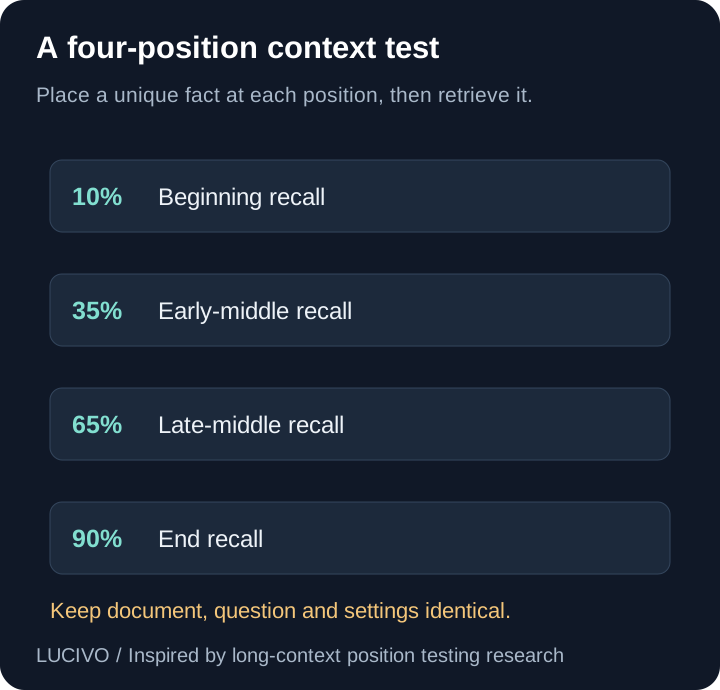
Create 20 to 40 short sections with similar formatting. Insert four unique statements at approximately 10%, 35%, 65% and 90% of the document. Use neutral invented facts such as:
Project Alder uses validation code MINT-4821.
The approved delivery day for Project Birch is Kestrel Tuesday.
Project Cedar’s exception owner is Team Umber.
Project Dune rejects records carrying flag VX-73.
Avoid famous names, predictable sequences and facts the model could infer. Ask one direct question about each statement. Then add a question that requires combining two distant statements.
Keep the comparison fair
Record the model identifier, interface, date, settings and document size. A consumer chat product and an API using a similarly named model may route, truncate, retrieve or summarize differently.
Use the same:
- Document text and order.
- System and user instructions.
- Question wording.
- Output format and token allowance.
- Tools, retrieval settings and file-processing route.
- Number of attempts.
Run each position separately first. Then ask all four questions in one request. This distinguishes isolated recall from handling several targets at once.
If the interface does not disclose token count, record characters, words and file size as practical proxies. Do not compare those measures directly with a provider’s token maximum because tokenization varies by model and language.
Score retrieval, evidence and reasoning separately
Use a small scorecard:
| Test | 0 | 1 | 2 |
|---|---|---|---|
| Retrieval | Missing or wrong | Partially correct | Exact fact recovered |
| Evidence | No support or wrong section | Vague location | Correct section or quotation |
| Reasoning | Unsupported conclusion | Right result with weak chain | Correct result using required facts |
| Instruction | Breaks required format | Minor deviation | Fully follows the format |
Record latency and input/output usage separately. A correct answer that takes much longer or costs several times more may still be unsuitable for a frequent workflow.
Do not average away critical errors. If a compliance workflow must always identify one exclusion clause, failure on that clause is a failed workflow even if the other three retrieval questions pass.
Add tests that resemble real documents
After the synthetic baseline, introduce one difficulty at a time:
- Repeated headings and similar clauses.
- Tables with notes beneath them.
- A corrected fact later in the document.
- Two facts that must be combined.
- An irrelevant section using similar terminology.
- A question whose answer is not present.
The absent-answer case tests whether the model admits the gap. A fluent invented answer is more serious than a missed retrieval.
For source-based work, apply the verification steps in how to check AI hallucinations. Long context supplies more possible evidence, but it also gives the model more irrelevant or conflicting material to misread.
Test the document position, not only the length
Many informal tests place one “needle” near the end and declare success. That does not show consistent use of the context. Move the same unique fact through the four positions while keeping everything else fixed.
Then test several lengths—for example, a short baseline, a typical working size and the largest size you expect. Do not test only the advertised maximum. A workflow that normally processes 40 pages needs reliable results around 40 pages more than an impressive answer on a contrived maximum-size prompt.
Repeat important cases. Generated output varies, and one pass can be luck. Report the number of successful runs rather than presenting a single screenshot as proof of a universal capability.
Go beyond a needle-in-a-haystack test
A needle-in-a-haystack test asks the model to retrieve one planted fact. It is useful for detecting truncation and position effects, but it does not show that the model can understand a long report, resolve a correction or combine evidence spread across sections.
Add at least three task types:
- Retrieval: Recover one exact synthetic fact and cite its section.
- Multi-hop reasoning: Combine two controlled facts placed far apart.
- Conflict resolution: Apply a later correction instead of repeating an earlier value.
The paper “Context Is What You Need” proposes measuring a maximum effective context window across increasing lengths and different problem types. For a practical product comparison, report a separate failure point for each task rather than turning them into one universal token number.
Watch for hidden retrieval and summarization
Some products do not place an entire uploaded file directly into the model context. They may index it, retrieve selected passages, summarize older messages or use another model for preprocessing. That can improve results, but it changes what you are measuring.
Ask the product to cite page or section locations. Compare the cited text with the source. If the product exposes retrieved passages, save them. A failure may come from retrieval rather than the language model.
The distinction mirrors RAG versus fine-tuning: retrieval chooses evidence at request time, while the language model generates from what it receives. Diagnose the stage that lost the information.
Longer context is not always the best design
Putting every document into one prompt can raise cost, latency and distraction. Consider three alternatives:
- Retrieval: Select the most relevant passages and retain source references.
- Structured extraction: Convert repeated document fields into a predictable table or record.
- Hierarchical summarization: Summarize sections, then combine them while preserving links to the originals.
Each alternative needs its own test. Retrieval can miss the right passage, extraction can drop nuance, and summaries can erase qualifications. The benefit is that failures become easier to inspect than an enormous undifferentiated prompt.
For local models, memory is another constraint. The best local LLMs for 16GB RAM guide explains why model size alone does not determine practical use; longer context also consumes memory through the KV cache. A model that technically loads may run out of room or slow down at the context length you want.
Turn the test into a buying decision
Before paying for a plan mainly because it advertises a large context window, test the actual interface and task. Use a free trial or small API budget where available and permitted. Record:
model and interface
document length
fact positions
retrieval passes / attempts
reasoning passes / attempts
citation accuracy
latency
input and output cost
observed truncation or upload limits
Compare models using the same evidence. Our ChatGPT vs Claude guide covers everyday workflow differences; the test above supplies task-specific evidence for long documents.
A result you can responsibly publish
A defensible conclusion sounds like this:
In this four-position synthetic document test, using the stated model, interface and date, the system retrieved three of four unique facts across three repeated runs. It missed the late-middle fact twice. This result applies to this setup and does not establish a universal context limit.
That wording is less dramatic than “the real context window is 64K,” but it is more useful. Usable context is not one permanent number. It is the observed reliability of a model, interface and workflow on a defined task.
Common Questions & Practical Answers
What is a usable context window?
It is the amount and arrangement of input a model can use reliably for a defined task, measured through retrieval, reasoning and output quality rather than the maximum accepted token count.
Does a one-million-token context window mean the model remembers every token?
No. It means the interface can accept up to that limit under stated conditions. Reliability can vary with position, task, document structure, model version and output requirements.
How can I test long context without sharing private documents?
Create a synthetic document with unique facts at controlled positions, use the same questions and settings, and record exact-match retrieval and explanation quality.
What is the difference between maximum and effective context window?
The maximum is the input capacity a system accepts. The effective or usable context window is the range over which it performs a defined retrieval or reasoning task reliably enough for your workflow.
Practical guides published by Lucivo, developed with AI assistance and references to official documentation. Examples are illustrative unless a guide explicitly documents a hands-on test. Check the linked sources for current product details.
Related articles

RAG vs Fine-Tuning: Which Does Your AI Project Actually Need?

Prompt Regression Testing: Test LLM Model Updates

Claude Fable 5.1: What Changed, Pricing and How to Use It
The Weekly Breakdown
High signal AI & software stories.
Direct to your inbox. No hype.
Independent analysis of AI models, developer tools, and computing architectures. Delivered every Sunday morning. 100% free.