Handle Webhooks That Arrive Out of Order
Handle delayed webhook events without moving application state backward, using provider state, versions and explicit transition rules.
The essentials
- Do not assume webhook arrival order matches the order in which the underlying changes occurred.
- Design the consumer around the object's valid state transitions or retrieve its authoritative current state when the provider's API and event model support that approach.
On this page
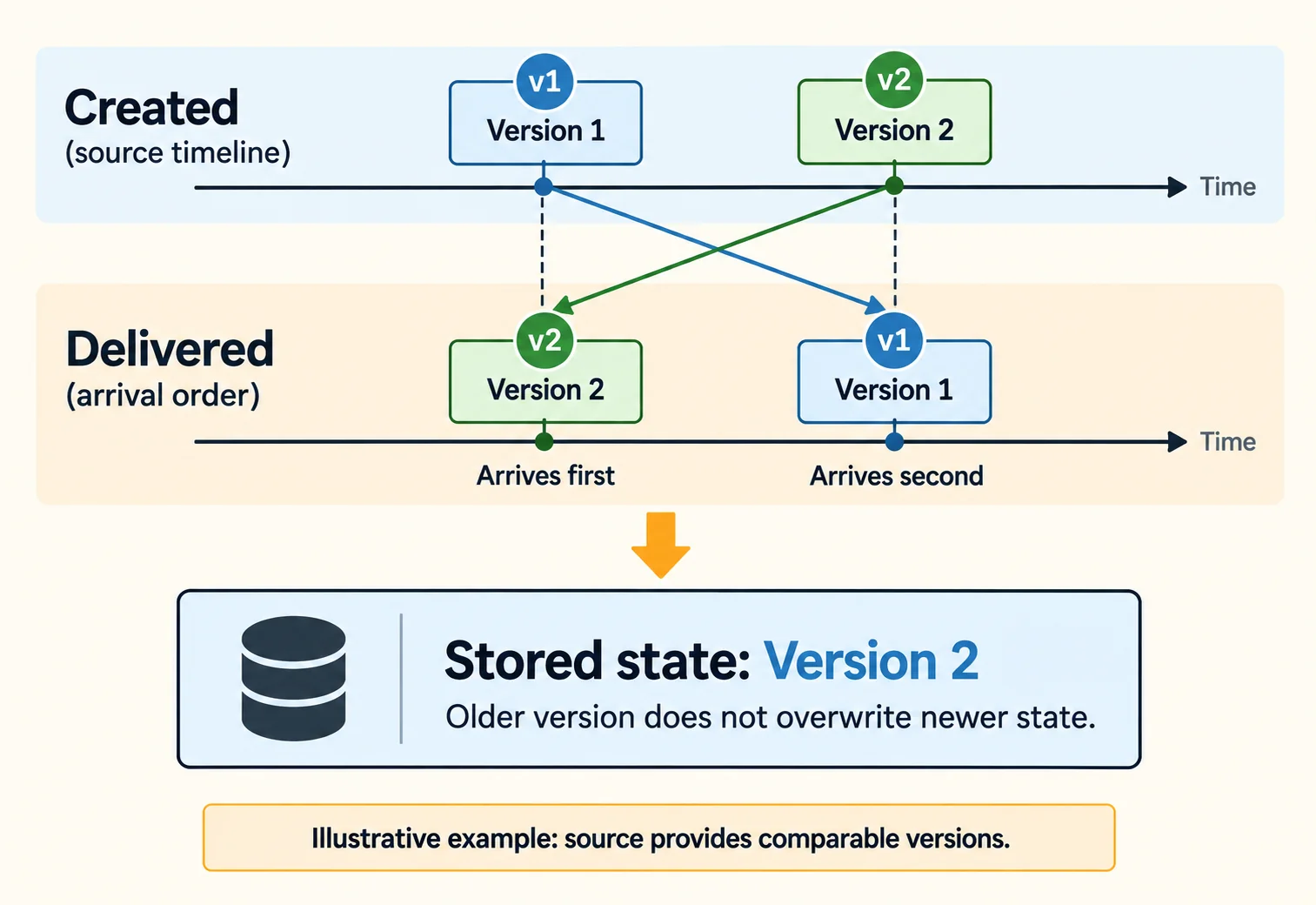
Do not assume webhook arrival order matches the order in which the underlying changes occurred. Design the consumer around the object's valid state transitions or retrieve its authoritative current state when the provider's API and event model support that approach.
Separate stale events from duplicate events
A duplicate repeats an event identity. An out-of-order event can be a different legitimate event delivered later than a newer one. Deduplicating event IDs does not solve stale updates.
Stripe's webhook guidance states that event ordering is not guaranteed. Verify the delivery and payload semantics of your own provider before using a timestamp or version as an ordering rule.
Store the event identifier, object identifier, event type, occurrence time and receipt time separately. They answer different questions.
Write the allowed state transitions
For an illustrative document-processing job, the states might be queued, processing, completed and failed. A late processing event should not overwrite a verified completed state merely because it arrived last.
| Current state | Incoming event | Decision to evaluate |
|---|---|---|
| Processing | Completed | Apply verified completion |
| Completed | Earlier processing | Preserve completion |
| Failed | New retry started | Identify a new attempt |
| Unknown | Completion | Retrieve or reconstruct required state |
This table is a design example. Your domain may legitimately allow reopening or reversal, so do not impose a universal monotonic order.
Choose a reconciliation strategy
If events provide a reliable object version, compare versions according to the provider's contract. If they are notifications to fetch current state, retrieve that state and update your local representation carefully.
If each event represents an immutable action, process the action once rather than simply replacing a current-state record.
Account for races between reconciliation workers. A read of current state followed by a delayed write can still overwrite a newer local update unless concurrency is controlled.
Preserve the event history
Keep enough sanitized history to explain why an event was ignored, applied or deferred. “Old event” should be a traceable decision, not a swallowed exception.
If prerequisite data is missing, place the event in a bounded retry or reconciliation queue. Do not assume that sleeping for a fixed interval makes every missing predecessor arrive.
Test shuffled sequences
Create a fixture sequence, then replay it in normal order, reverse order and with duplicates. Include a retry attempt and a legitimate reversal if your business process allows them.
The expected final state should be defined before running the test. Also verify the number of external side effects.
For an AI agent application, an older status event should not restart completed work. Keep this lifecycle logic in the application rather than asking the model to infer event chronology.
Related troubleshooting
This guide draws on the linked documentation. Examples are illustrative unless explicitly identified as measured results.
Practical guides published by Lucivo, developed with AI assistance and references to official documentation. Examples are illustrative unless a guide explicitly documents a hands-on test. Check the linked sources for current product details.
Related articles
AI Streaming Arrives All at Once Behind NGINX
API Key Committed to Git: What to Do Next
API Timeout: Is It Safe to Retry?
The Weekly Breakdown
High signal AI & software stories.
Direct to your inbox. No hype.
Independent analysis of AI models, developer tools, and computing architectures. Delivered every Sunday morning. 100% free.